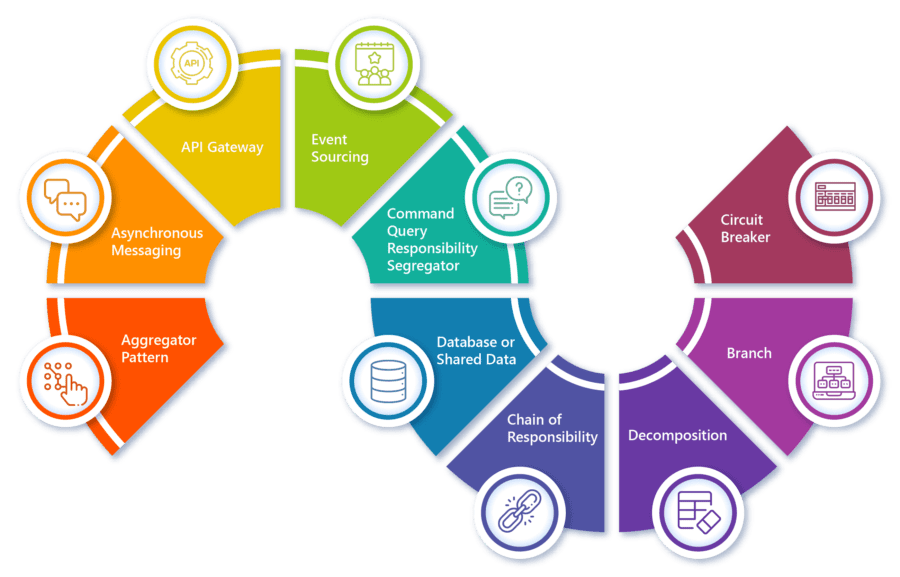
Microservices

Scalability
Scale the services under real load — checkout, search, whatever's under pressure — without paying to scale the parts of the system that don't need it.

Flexibility
Smaller, focused services mean new features ship faster, without a full-system regression test every time something changes.

Break Down Monoliths Without Breaking the Business

A monolith that's hard to scale, deploy, or hand off between teams eventually slows every release down. We break applications into independent, scalable services that work together as one system — migrated incrementally, so the business stays running throughout.

Key Features of Our Microservices Solutions

Independent Services
Each service is developed, deployed, and scaled on its own — a change to one doesn't mean re-testing and re-deploying everything else.

Resilience
A failure in one service doesn't take down the whole application, so a single bug or outage doesn't mean a full-system incident.

Ongoing Support
We don't hand off a distributed system and disappear — continuous monitoring and rapid troubleshooting are part of the engagement, not a separate line item you discover you need later.

What This Means for Your Business

Faster Time to Market
Independently deployable services mean a new feature ships when it's ready, not on the release schedule of everything else in the application.

Lower Infrastructure Spend
You scale the services under real demand, not the whole application — resources go where the load actually is, not everywhere by default.

Teams Can Work in Parallel
Separate teams can build, test, and release different services at the same time without blocking each other or fighting over the same codebase.

The Right Tool for Each Job
Different services can use different languages, frameworks, or databases where it genuinely fits — you're not forced into one stack for every problem.

Smaller, Safer Releases
A release touches one service, not the entire application — smaller changes are easier to test, easier to roll back, and less likely to cause a production incident.

Microservices

Why Choose Akantik?

Our engineers help you modernize legacy systems into microservices or design a new, scalable application from the ground up — whichever stage you're starting from.

Have a monolith that's slowing your team down? Let's plan the migration path.

Microservices Architecture FAQs

Common questions about microservices development and scalable software solutions.

What are microservices and how do they differ from monolithic architecture?

Microservices is an architectural approach where an application is built as a collection of small, independent services. Key differences from monolithic architecture:

  • Monolithic: All components tightly coupled in a single codebase
  • Microservices: Each service is independent and handles a specific business function
  • Services can be developed, deployed, and scaled independently
  • The system becomes more flexible, resilient, and easier to maintain
When should my business consider migrating to a microservices architecture?

You should consider microservices when:

  • Your monolithic application is becoming difficult to scale, deploy, or maintain
  • Different parts of your application need to scale at different rates
  • Your development teams are growing and need to work independently
  • You need faster release cycles and continuous deployment capabilities

Akantik Solution can help you assess whether microservices are the right fit for your business needs.

How does Akantik Solution ensure fault tolerance in microservices?

Because each microservice operates independently, a failure in one service does not bring down the entire application. Akantik Solution implements:

  • Circuit breaker patterns to prevent cascading failures
  • Retry mechanisms and health checks
  • Graceful degradation strategies
  • Service redundancy for critical functions

These measures ensure maximum uptime and system reliability.

What technologies does Akantik Solution use for microservices development?

Akantik Solution leverages modern cloud-native technologies including:

  • Docker for containerization
  • Kubernetes for orchestration
  • API gateways for service communication
  • RabbitMQ and Kafka for asynchronous messaging
  • CI/CD pipelines for automated deployment

We work with .NET Core, Node.js, and other frameworks depending on your project requirements.

How do microservices improve time to market for new features?

Microservices accelerate time to market by enabling:

  • Parallel development across multiple teams working on different services simultaneously
  • Independent deployment of individual services without redeploying the entire application
  • Faster testing cycles since each service can be tested in isolation
  • Rapid iterations and feature updates

This approach allows businesses to respond to market demands much faster than with traditional architectures.

Can Akantik Solution help migrate my existing monolithic application to microservices?

Yes, Akantik Solution specializes in modernizing legacy monolithic systems. Our approach includes:

  • Using the strangler fig pattern for incremental migration
  • Gradually extracting functionality into independent services
  • Keeping your application operational throughout the migration
  • Minimizing risk and ensuring business continuity

This phased approach ensures a smooth transition without disruption to your operations.

Hire Us