AI Solutions for Manufacturing

Unplanned downtime, defects caught after the fact, and a schedule built on gut feel are expensive habits on a production line. AI applied to the data your equipment already generates catches these problems earlier — without replacing the plant floor's existing tooling.

We build on top of your existing MES and SCADA systems rather than asking you to rip them out, so AI capability gets added to the floor without a disruptive re-platforming project.

Whether the priority is catching equipment failure before it happens or tightening a scheduling process that's still run on spreadsheets, we scope the use case to what will actually move the numbers you're measured on.

What We Build for Your Production Floor

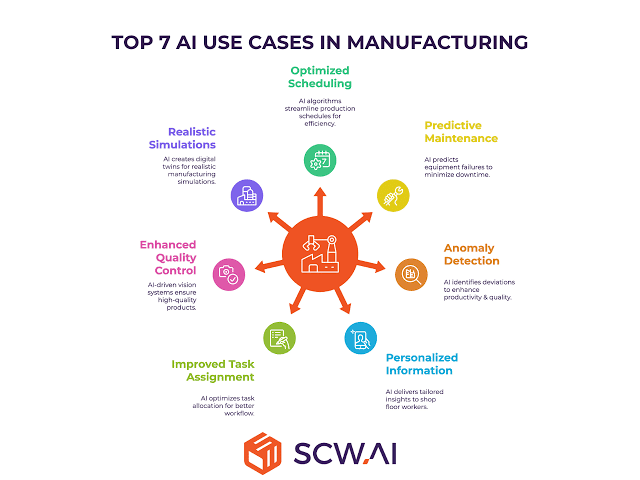
1. Predictive Maintenance: Sensor and machine data train a model that flags a likely failure before it happens, so maintenance gets scheduled around production instead of forcing an emergency stop.
AI for Manufacturing

2. Computer Vision Quality Inspection: Cameras on the line feed a vision model trained to catch defects at production speed — more consistent than manual inspection and able to run every shift without fatigue.

3. Production Scheduling Optimization: Order priority, machine availability, and changeover time feed a model that builds a schedule tighter than a planner working from a whiteboard and a spreadsheet.

4. Supply Chain and Demand Forecasting: Historical demand, lead times, and current orders feed a forecasting model that gives purchasing a heads-up on a shift before it turns into a shortage.

5. Integration With MES and SCADA: We build against the data your existing MES and SCADA systems already generate, so AI gets added as a capability on top — not a reason to replace floor systems that already work.

Why Choose Akantik for AI in Manufacturing?

A model trained on a vendor's demo dataset doesn't know your equipment, your defect types, or your line speed. We train on your actual production data, or help you start capturing it if you're not yet.

Built to Run on the Floor: We design for real production conditions — lighting, vibration, line speed — not a clean lab environment that doesn't hold up on shift one.

Works With Legacy Equipment: Older machines without modern sensors can often still be instrumented cost-effectively — we assess what's feasible before recommending a hardware upgrade.

Measured Against Production Metrics: Success is defined by downtime reduced, defects caught, or forecast accuracy improved — not a demo that looks good in a meeting.

Losing time to unplanned downtime or defects caught too late? Let's see what your production data can already tell you.

AI for Manufacturing

AI for Manufacturing - Frequently Asked Questions

Common questions about applying AI to production, maintenance, and supply chain operations.

What is predictive maintenance and how much data does it need?

Predictive maintenance uses sensor and machine data to flag a likely failure before it happens, so maintenance is scheduled proactively.

It typically needs historical sensor data alongside past failure records to train an accurate model, though we can help set up data capture if it doesn't exist yet.

Can computer vision quality inspection replace manual inspectors entirely?

It typically augments rather than fully replaces manual inspection at first, catching high-confidence defects automatically while routing uncertain cases to a human reviewer.

Coverage expands as the model proves accurate on your specific defect types.

Does Akantik require us to replace our existing MES or SCADA system?

No, we build AI capabilities that integrate with your existing MES and SCADA systems through their existing data feeds and APIs, adding AI as a capability layer rather than requiring a re-platforming project.

How does AI improve production scheduling?

A scheduling model factors in order priority, machine availability, and changeover time to build a tighter schedule than manual planning typically achieves, reducing idle time and late orders.

What if our older equipment doesn't have modern sensors?

Many legacy machines can be retrofitted with cost-effective sensors to enable predictive maintenance and monitoring.

We assess feasibility for your specific equipment before recommending any hardware investment.

Hire Us