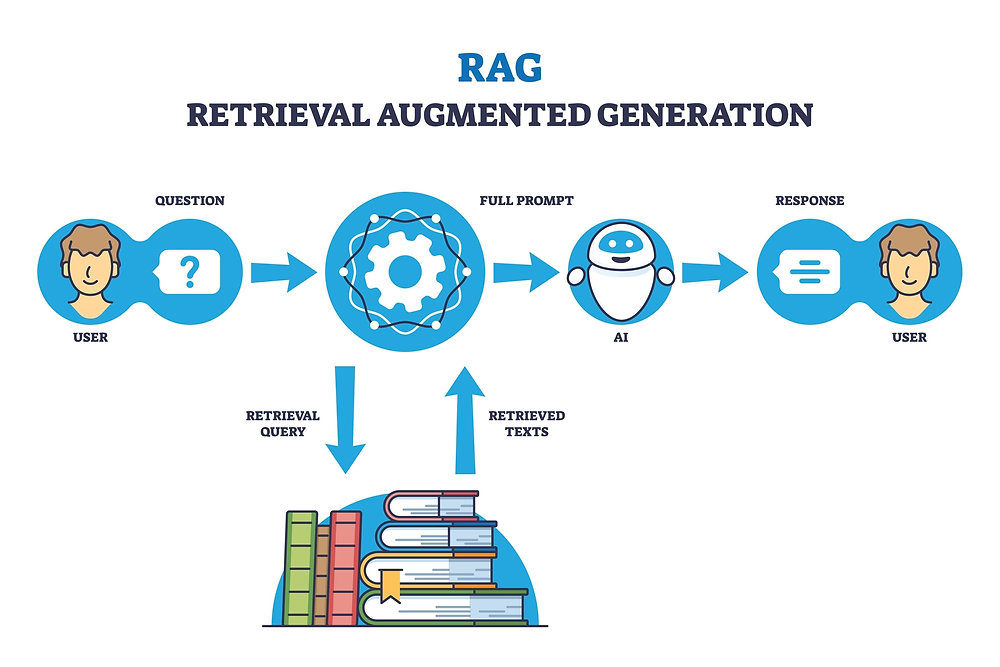
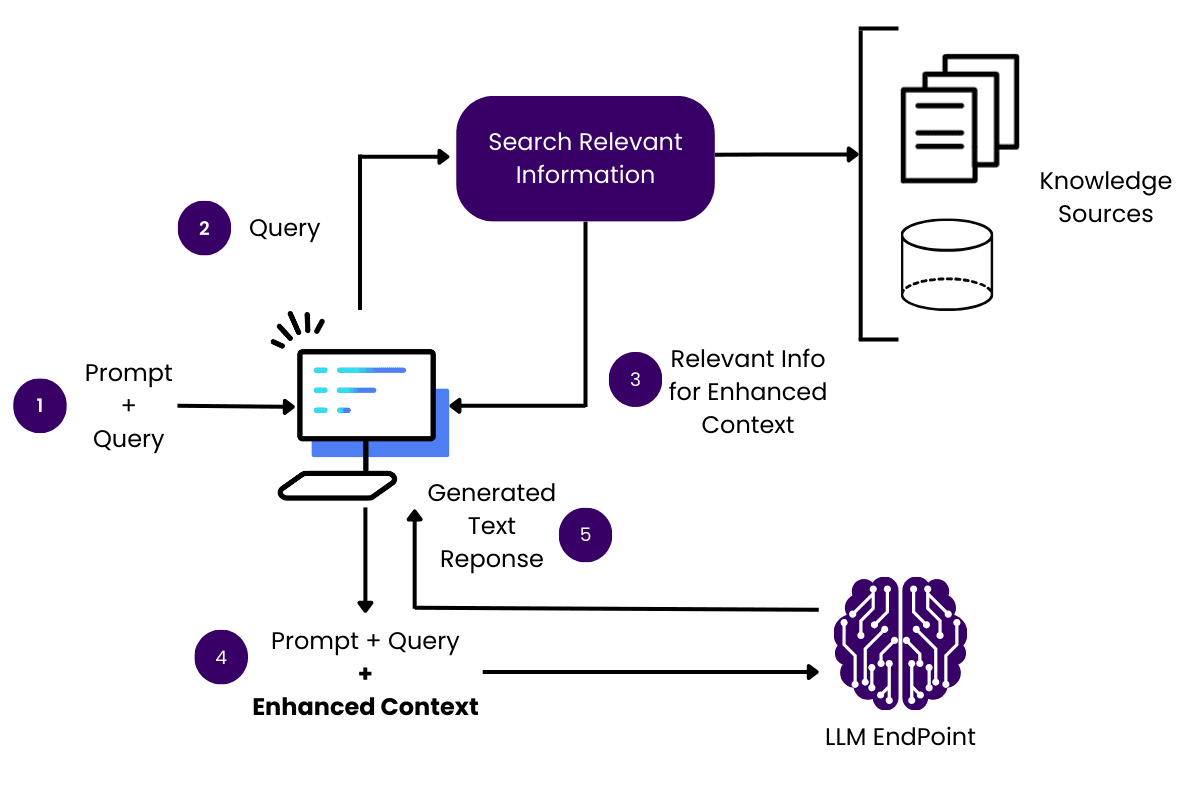
An LLM on its own doesn't know your product catalog, your pricing rules, or last week's policy change. RAG fixes that by retrieving the relevant piece of your actual data before the model answers — grounding the response instead of letting it guess.
The quality of a RAG system comes down to details most demos skip — how content is chunked, how it's embedded, and how retrieval is evaluated. We build for those details, not just a working prototype.
Whether you're grounding a chatbot, a search tool, or an internal assistant, we architect the retrieval pipeline around your actual content and query patterns.
What We Build Into Your RAG Pipeline
1. Chunking Strategy That Preserves Meaning: Documents are split in ways that keep context intact, instead of arbitrary fixed-length cuts that split a table or a clause mid-sentence.
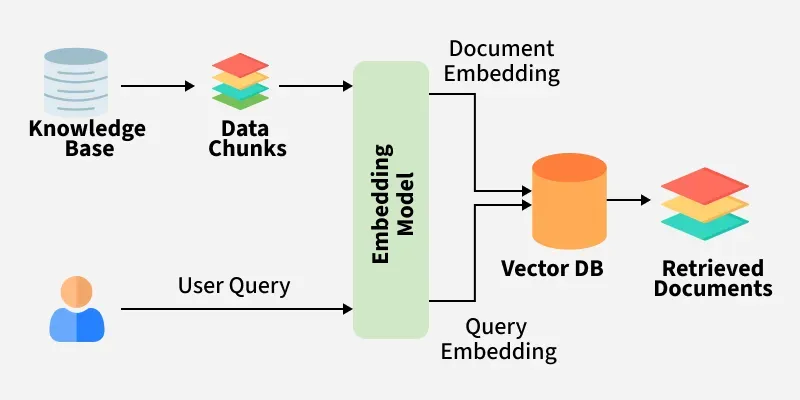
2. Embeddings Tuned to Your Content: We pick and tune the embedding model based on your domain — technical documentation, legal text, and product data don't retrieve well with the same defaults.
3. Hybrid Search, Not Just Semantic: Keyword and semantic search run together, so an exact product code or error message still gets found even when vector similarity alone would miss it.
4. Grounded Answers Over Confident Guesses: The model is constrained to answer from retrieved content, and told to say when it doesn't know — instead of filling gaps with a plausible-sounding hallucination.
5. Evaluation That Catches Drift: We test retrieval quality against real queries on an ongoing basis, so accuracy is tracked and tuned instead of assumed to stay good after launch.
Why Choose Akantik for RAG Solutions?
A RAG demo that retrieves the right document in a five-minute test is easy. One that holds up against thousands of real documents and messy real queries is where most projects fall apart. We build for the second case.
We Test Against Your Real Content: Chunking and retrieval get tuned against your actual documents, not a clean sample dataset that doesn't reflect production.
Built to Scale Past a Demo: Vector store choice, indexing strategy, and query latency are architected for the volume you'll actually have, not the volume in a pitch deck.
Ongoing Accuracy Tuning: We monitor real query performance after launch and adjust retrieval as usage patterns and content evolve.
Have an AI tool that needs to answer accurately from your own data? Let's design the retrieval pipeline behind it.
Common questions about retrieval-augmented generation and grounding AI in your own data.
RAG is an architecture that retrieves relevant pieces of your own data before an LLM generates a response, grounding the answer in real content instead of relying purely on what the model learned during training.
By constraining the model to answer based on retrieved, relevant content rather than its general training data, and instructing it to indicate when the answer isn't in the retrieved content, RAG significantly reduces fabricated or inaccurate responses.
Chunking splits documents into smaller pieces for retrieval.
This directly determines how accurate and relevant retrieved answers are.
Hybrid search combines keyword search with semantic (vector) search.
It matters when queries include exact terms — product codes, error messages, names — that semantic search alone can miss, so most enterprise RAG systems benefit from it.
We test retrieval against a set of real, representative queries and measure whether the right content is being found and used correctly.
This evaluation continues after launch to catch drift as content and usage patterns change.